

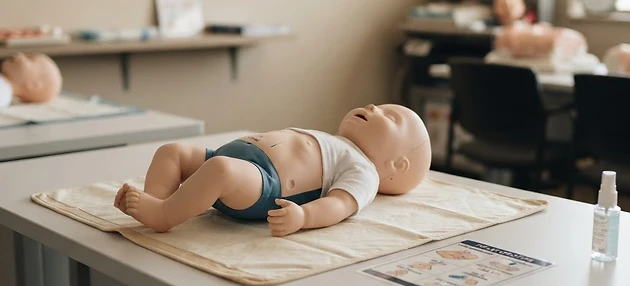
Every Parent Should Know This
Knowing what to do if your baby is choking or needs CPR is one of the most important skills a parent can learn. This article gives you an overview, but it is not a substitute for a certified CPR course. We strongly encourage every parent, grandparent, and caregiver to take a hands-on infant CPR class.
SAFETY
If your baby is not breathing or is choking and turning blue, call 911 immediately. If you are alone, start CPR or choking rescue first, then call 911 after 2 minutes of care.
Choking: What to Look For
A baby who is choking may:
- Have difficulty breathing, coughing, or crying
- Make high-pitched sounds or no sound at all
- Have bluish lips or skin
- Appear panicked or go limp
If your baby can cough or make sounds, let them cough — coughing is the most effective way to clear an airway. Do not intervene unless they cannot breathe, cough, or cry.
Infant Choking Rescue (Under 1 Year)
If your baby cannot breathe, cough, or cry:
- 5 Back Blows: Hold the baby face-down along your forearm, head lower than their chest. Support their head and jaw. Give 5 firm blows between the shoulder blades with the heel of your hand.
- 5 Chest Thrusts: Turn the baby face-up along your opposite forearm, head lower than their body. Place two fingers in the center of their chest (just below the nipple line) and give 5 quick, firm thrusts.
- Alternate between 5 back blows and 5 chest thrusts until the object is dislodged or the baby becomes unresponsive.
- If the baby becomes unresponsive, begin infant CPR and call 911.
SAFETY
Never do abdominal thrusts (the Heimlich maneuver) on a baby under 1 year — it can cause serious injury.
Infant CPR (Under 1 Year)
If your baby is unresponsive and not breathing:
- Check for responsiveness: Flick the bottom of their foot. If no response, begin CPR.
- 30 Compressions: Place two fingers in the center of the chest. Push down about 1.5 inches at a rate of 100–120 compressions per minute. Let the chest fully recoil between compressions.
- 2 Rescue Breaths: Gently tilt the head back slightly, cover the baby's nose and mouth with your mouth, and give 2 gentle puffs — just enough to make the chest rise.
- Continue cycles of 30 compressions and 2 breaths until help arrives or the baby starts breathing.
What You Can Do
- Take a certified infant CPR and choking course (American Red Cross or American Heart Association)
- Keep emergency numbers saved in your phone
- Share what you learn with grandparents, babysitters, and other caregivers
- Practice on a doll or manikin — muscle memory matters in an emergency